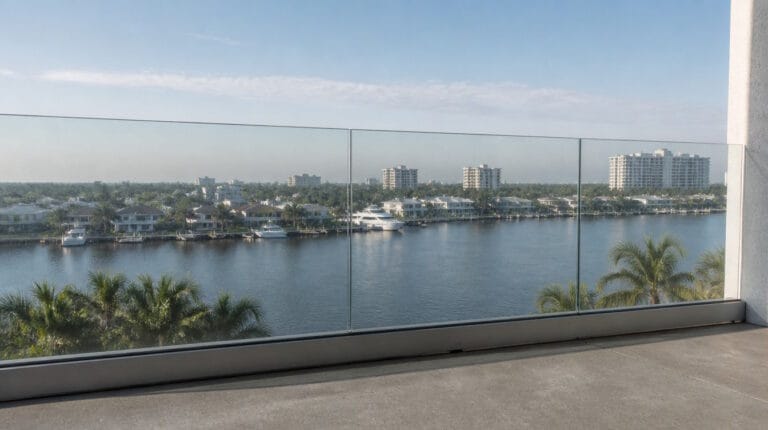

Does a Glass Pool Fence Meet Florida Code?
Short answer: yes — a glass pool fence can fully comply with Florida law, and in some ways it’s one of the easiest barrier types to get right. But compliance has nothing to do with the material. Florida’s pool barrier rules are written around measurements and gate behavior, not what the panels are made of. A glass fence passes or fails on exactly the same numbers as a mesh or aluminum one.
That’s good news if you want the view. It also means a beautiful frameless glass fence installed slightly wrong will fail inspection just as fast as anything else. Here’s what the code actually requires, and where glass has an advantage.
The law that governs your pool fence
Residential pool safety in Florida is governed by Chapter 515 of the Florida Statutes, the Residential Swimming Pool Safety Act. Your local building department applies it through the Florida Building Code’s residential pool barrier provisions during inspection.
The law doesn’t force you to build a fence. It requires that a residential pool have at least one approved safety feature:
- A barrier that isolates the pool from the home
- An approved safety pool cover
- Exit alarms on all doors and windows with direct pool access, rated at a minimum of 85 dB at 10 feet
- Self-closing, self-latching devices on those doors, with the release no lower than 54 inches above the floor
- A pool alarm that detects entry into the water
A fence is the most common choice because it works passively. Alarms depend on batteries and on nobody disabling them; a barrier just stands there.
The four numbers that decide compliance
If you remember nothing else from this page, remember these.
48 inches minimum height. Measured on the outside — the non-pool side. This is where glass fences most often get specified short, because panel heights are frequently sold in standard sizes that look tall enough but measure under once the base hardware and deck level are accounted for.
4 inches maximum opening. No gap, opening, indentation or protrusion may allow a young child to crawl under, squeeze through, or climb over the barrier. For glass, the relevant gaps are the vertical joints between panels and around the spigots.
2 inches maximum gap underneath. The clearance between the bottom of the barrier and the deck.
54 inches for the gate latch release. Measured from the ground, on the outside of the gate.
Gates are where most fences fail
The panels are rarely the problem. The gate almost always is.
Florida requires that every gate providing access to the pool:
- Opens outward, away from the pool
- Is self-closing — it returns to the closed position on its own
- Is self-latching — it catches and locks when it closes, with no manual bolt to slide
The latch release must sit at least 54 inches above the ground. There’s an alternative placement: the release can be on the pool side of the gate, but then it has to be at least 3 inches below the top of the gate, and no opening larger than half an inch can exist within 18 inches of the latch. In practice, the 54-inch exterior placement is simpler and what most inspectors expect to see.
A very common failure: the latch sits at 48 inches because that matched the fence height. It doesn’t pass.
Where a glass pool fence has the advantage
Now the part that’s specific to glass.
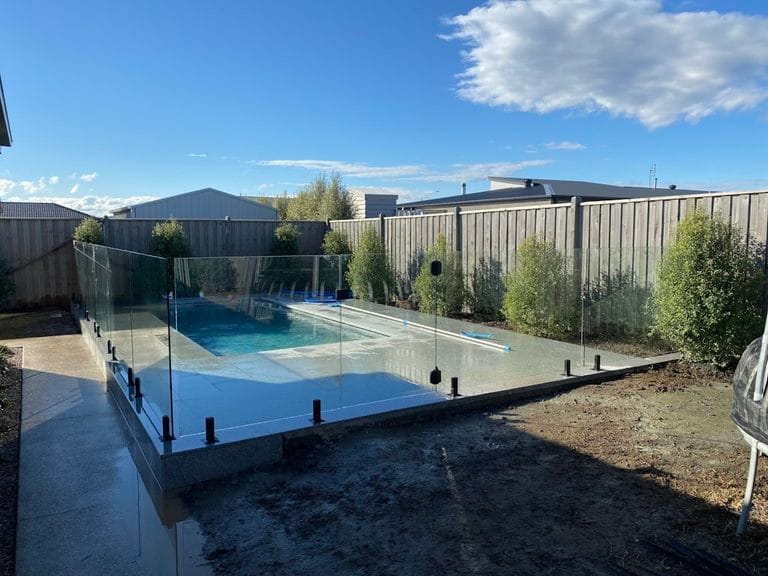
Nothing to climb. The single biggest structural risk in a pool barrier is a child climbing it. Horizontal rails, mesh texture, decorative scrollwork — all of it gives a foothold. A frameless glass panel offers none. This isn’t just an aesthetic preference; it’s the “climb over” clause of the statute, and glass answers it better than almost any other material.
Full visual supervision. An adult inside the house or on the patio can see the entire pool area through the barrier. A solid or mesh fence creates blind spots. The law doesn’t credit you for this, but it matters in practice, and it’s the reason many South Florida families with young children choose glass over the alternatives.
The barrier stays a barrier. Glass doesn’t sag, stretch or develop gaps the way mesh can over several seasons of sun and heat.

Where glass pool fences fail inspection
Being honest about this matters more than selling the material.
Spigot spacing and panel gaps. Frameless glass fences are supported by spigots or a base channel, and the vertical gaps between panels are a design choice. Set too wide, they violate the 4-inch rule. This is the most common glass-specific failure.
Panel height measured after installation. The finished height depends on the spigot, the base, and the deck surface. A panel that measures 48 inches on its own may finish under 48 inches once mounted — or the reverse, if it’s set on a raised base. It has to be measured in place.
Deck clearance. Frameless systems sit above the deck by design. That clearance has to stay within 2 inches, and on an uneven or sloped pool deck it can open up at one end without anyone noticing.
Gate hardware quality in salt air. This isn’t a code issue on day one, but it becomes one. A self-closing hinge that has corroded and no longer returns the gate fully is a non-compliant barrier, even though it passed inspection three years ago. Near the ocean or the Intracoastal, marine-grade hardware isn’t a luxury — it’s what keeps the barrier legally compliant over time. The same principle applies across all coastal railing work, as we cover in our glass vs aluminum comparison.
What happens if your barrier doesn’t comply
Failing to equip a residential pool with at least one required safety feature is a second-degree misdemeanor under Florida law. In practice, a homeowner generally has 45 days to correct the violation and complete a state-approved drowning prevention education program, after which charges are typically dropped.
The more immediate risk is insurance. Homeowner policies commonly require compliance with applicable safety laws, and a non-compliant barrier can complicate or defeat a claim after a pool incident. That exposure alone usually outweighs whatever was saved by cutting a corner on gate hardware.
Replacing an existing pool barrier with glass
If you already have a compliant fence and want to swap it for glass, the project is usually straightforward — but treat it as a new barrier, not a like-for-like replacement. The panel layout, spigot positions, gate swing and latch height all change. Anything that was compliant in the old configuration has to be re-established in the new one.
Two things worth confirming before anything is ordered:
- Whether a permit is required. It often is when the barrier is being replaced rather than repaired, and requirements vary between Boca Raton, Fort Lauderdale and the unincorporated parts of Palm Beach and Broward County.
- Whether your HOA has its own standard. Many South Florida communities regulate barrier appearance separately from the county. HOA approval is not the same as code compliance, and you need both.

Is a glass pool fence legal in Florida?
Yes. Florida’s pool barrier law regulates height, gaps and gate operation, not materials. A glass fence that meets the 48-inch height, 4-inch opening and 2-inch under-gap limits, with a compliant self-closing and self-latching gate, is fully code-compliant.
How tall does a glass pool fence have to be in Florida?
At least 48 inches, measured on the outside of the barrier. The measurement is taken after installation, so the finished height including the base hardware and deck surface is what counts.
Can the house wall count as part of the pool barrier?
Yes, but if it does, every door and window providing access from the house to the pool area must be equipped with compliant alarms or self-closing, self-latching hardware. Using the home as one side of the barrier trades fencing cost for hardware requirements on every opening.
Does a glass pool fence need a gate?
Only if you need access through it. If the pool area is reached another way, the barrier can be continuous. Where there is a gate, it must open outward, be self-closing and self-latching, with the latch release at least 54 inches above the ground.
Is a screen enclosure enough on its own?
A screen enclosure can qualify as an approved barrier, but the details matter — the doors within it have to meet the same self-closing and self-latching requirements. Confirm with your building department before assuming an existing cage satisfies the code.
Do these rules apply to an existing pool?
Chapter 515’s inspection requirements attach to new residential pools at final inspection. Existing pools may fall under different local enforcement, and any barrier you build or replace today will be inspected against current code. If in doubt, ask your building department about your specific property.
Getting it right the first time
Every glass pool fence we install in South Florida is measured on site and laid out so the panel gaps, finished height, deck clearance and gate hardware meet Florida’s barrier requirements as a complete system — not as parts that each look about right.
If you’re planning a new pool barrier or replacing one that no longer passes, see our glass pool fence page or contact us for a free on-site consultation. We’ll measure the deck, check the gate positions and tell you exactly what the project needs before anything is ordered.
This page explains general requirements under Florida law and is not legal advice. Local requirements vary — confirm specifics with your building department.